 online
languages for children
online
languages for children

 online
languages for children
online
languages for children
Just like you, your children have their everyday worries that occupy their minds. There are rules to free both you and your children from those worries, so they could be replaced by a new experience: learning and speaking in a new language. So how can we turn away from our everyday worries and free our minds for learning?
Below you'll find nine tips of an experienced teacher.
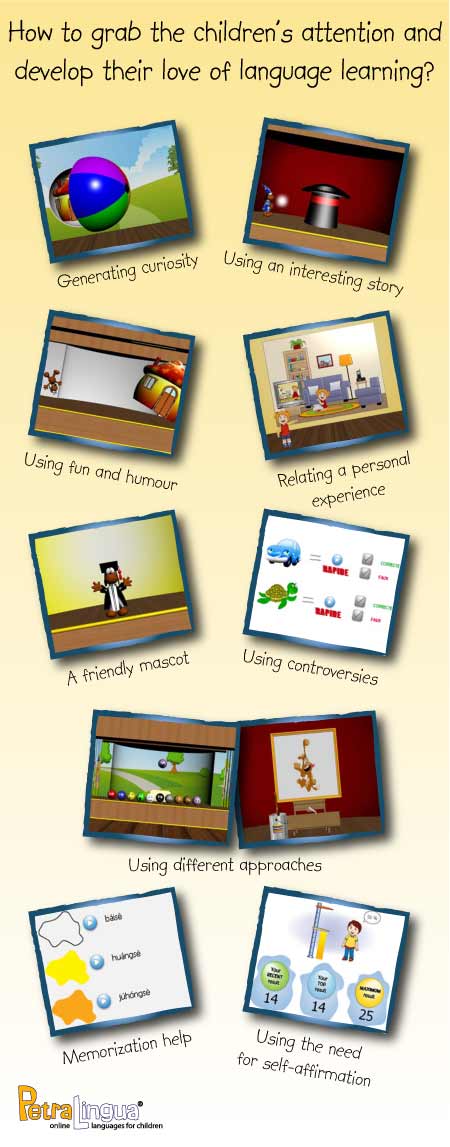
What's in the magic ball?
As the video begins, we don't know what is inside the magic ball and we're curious to see what we'll learn in this lesson.
The story of the magician and his hat
What is comming out of the magic hat? Pencils, books, notebooks and other school things that we are going to name in this lesson.
Thunderstorm
Just like in a cartoon, Woofy and his house get carried away by hurricane. Of course, the story has a happy ending and the children have fun naming the weather conditions.
Children's room
In the video set in a familiar environment we learn the names of furniture and rooms of the house.
Hello, my name is Woofy!
Each topic is introduced by Woofy, the dog mascot of the courses. He also takes active part in many videos.
Is the turtle fast?
This controversy can only be solved by making conclusions, which requires additional efforts.
Learning the color words
Watching this interesting animated video, we learn the words for colors of balls that appear on the stage. All the balls are the same, but have different colors.
Describing things and animals
We use the color words we just learned to describe things and animals we can already name.
Repeated listening to the audio picture dictionary helps us memorize the words.
The audio picture dictionary can be used to help us remember the words, repeat the words after the speaker, but also to practice writing.
Points scored at the end of the lesson compared to the maximum score and personal top score of the child
Keeping track of points the children score at the end of each lesson helps develop their competitive spirit. The lessons aren't excessively difficult and it's easy to make progress.
More details about PetraLingua courses: English, Spanish, French, German, Russian, Chinese
Join our mailing list to receive news from PetraLingua packed with information, tips and exclusive offers!



Copyright © 2017.-2026. PetraLingua Publishing, all rights reserved. PetraLingua® is a registered trade mark of PetraLingua Publishing.
Design by Bruckom